
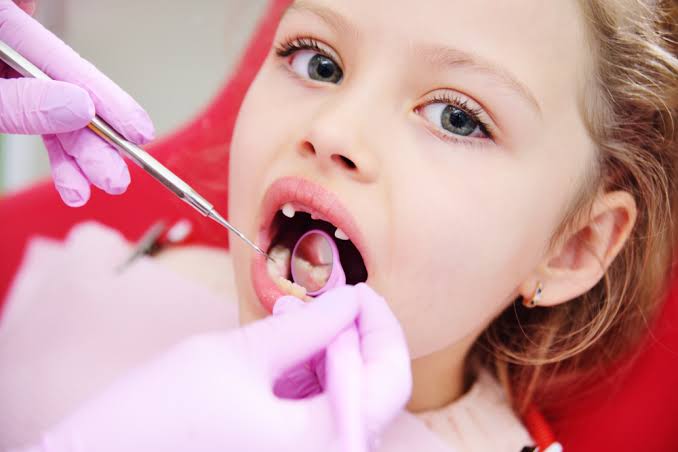
Government data for the year ending 2025 shows something worth sitting with: children in Yorkshire and the Humber are extracted at a higher rate, due to decay, than children anywhere else in England. Not slightly higher. More than double the national average.
The numbers, plainly
Across England, NHS hospitals carried out 56,143 tooth extractions on children up to 19 in the year ending 2025, a 14% rise on the year before. Of those, 33,976 had a primary diagnosis of tooth decay, up 11%. Decay remains the single most common reason a child aged five to nine ends up admitted to hospital in England, ahead of tonsillitis, ahead of anything else.
Regionally, the gap is stark. Yorkshire and the Humber recorded 504 decay-related extractions per 100,000 children, against a national average of 251 and a low of 73 in the East Midlands. That’s not a one-off bad year either. Similar patterns showed up in data going back over a decade, which points to something structural rather than a temporary blip.

A fair caveat
Before treating this as beyond question, it’s worth noting that the British Society of Paediatric Dentistry has described this data set as incomplete. Hospital extraction figures capture a specific slice of the picture, the most severe cases that require a hospital admission, rather than the full spread of childhood tooth decay across the region. The broader trend still holds up, but it’s fair to read the headline stat with that context attached rather than as a precise ranking.
Why Yorkshire, specifically
The clearest explanatory factor in the national data is deprivation. Children in the most deprived communities are more than three times as likely to need a decay-related extraction as those in the least deprived areas. Nationally, around a quarter of five-year-olds in England have tooth decay, rising to as much as 50% in areas of higher deprivation. Yorkshire and the Humber includes some of England’s more deprived districts, which goes a long way toward explaining why the region sits where it does on this list.
It’s less about anything unique to the region’s water or genetics, and more about the well-established link between household income, access to preventive dental care, and diet.
What Bradford is already doing about it
This is where the story gets more useful than just alarming. Bradford isn’t waiting for national policy to catch up. Bradford District Care NHS Foundation Trust runs a dedicated Oral Health Improvement team, which delivers a supervised toothbrushing programme for children aged four to six and a fluoride varnish programme for ages three to five, both targeted specifically at schools and nurseries in the areas with the highest decay rates across the district.
Bradford is also directly involved in the research behind these programmes nationally. The BRUSH project, a free toolkit built to help schools and nurseries run effective supervised toothbrushing schemes, was developed jointly by the University of Leeds, the University of Sheffield and the Bradford Improvement Academy. Nationally, the Department for Education and the Department of Health and Social Care allocated £11 million for 2025/26 to expand supervised toothbrushing to around 600,000 children aged three to five in England’s most deprived areas.
None of this fixes the problem overnight. But it does mean Bradford families aren’t starting from zero.
What actually prevents decay
Away from the headline stats, the prevention advice is genuinely simple and well established:
- Start brushing as soon as the first tooth appears, usually around six months, using fluoride toothpaste. A smear is enough up to age three, moving to a pea-sized amount after that.
- Brush twice a day for two minutes, last thing before bed and at one other point in the day. Spit, don’t rinse, so the fluoride keeps working.
- Keep sugary food and drink to mealtimes rather than grazing throughout the day. It’s the frequency of sugar exposure that does the damage, not just the total amount.
- Book that first dental visit by your child’s first birthday, or as soon as the first tooth appears, whichever comes first. It’s not really a clinical exam at that age. It’s mostly about your child getting used to the environment and you getting practical brushing advice tailored to their teeth.
- Keep checkups regular after that, generally every six to twelve months depending on what the dentist recommends for your child specifically.
None of this requires anything expensive or complicated. It’s routine, repeated early, and kept up.
Where to start
If your child hasn’t had a dental checkup yet, or it’s been a while, that’s the single most useful next step. A proper look at children’s dental checkups is a good place to understand what a first visit actually involves and when to book one, rather than waiting until a problem shows up on its own.
Yorkshire’s numbers are genuinely worse than the rest of England’s. But decay is also, as the data itself keeps pointing out, almost entirely preventable. Starting early is still the single biggest factor within a family’s control.


